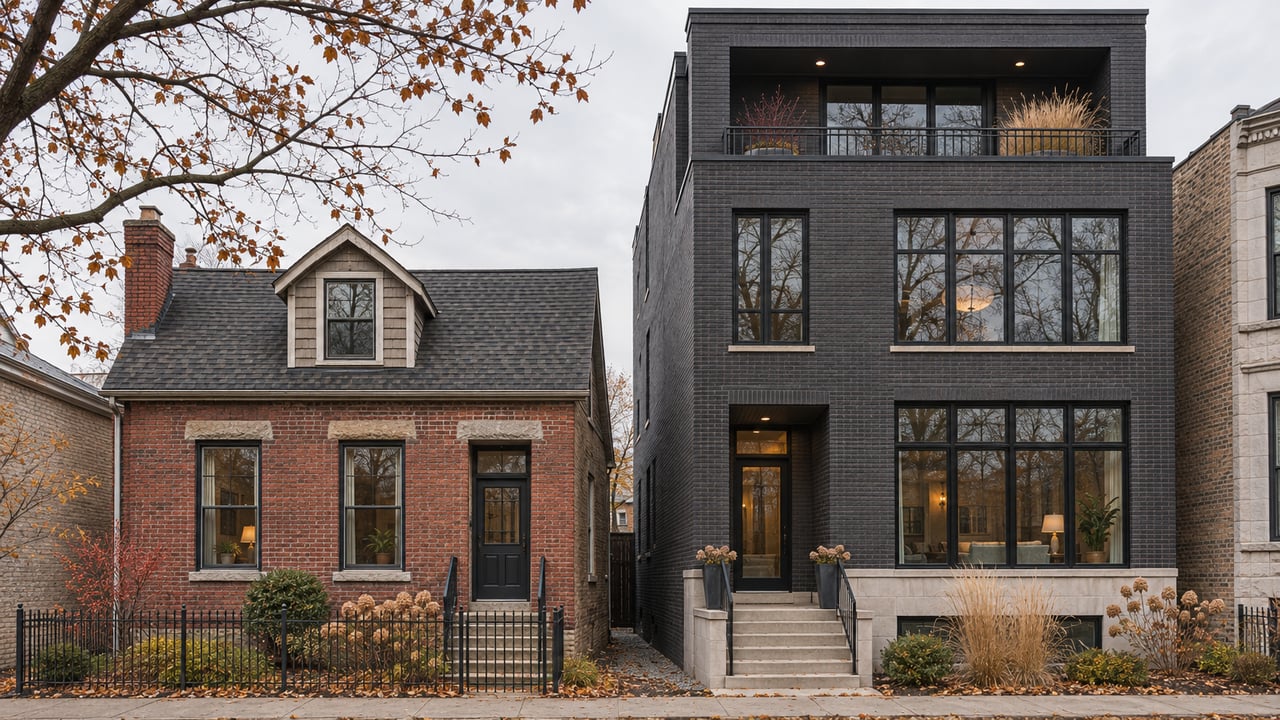
An 1888 frame house stood on the corner of Armitage Avenue and Wood Street. It was marketed as a teardown, and some listings showed it as sold before they even went to print. An LLC bought it for $525,000 in October 2025, and the city issued a demolition permit on December 12. On January 12, 2026, the city permitted a three-story-plus-basement building with one duplex-down unit and one duplex-up unit at 1803 W. Armitage, according to Chicago YIMBY. One of the two new units has been listed at $1.375 million.
Look at what that one listing says about Bucktown pricing. The asking price for a single unit is higher than the builder's land price plus the permit cost for the whole two-unit building. That gap explains a lot about who bids on older Bucktown houses and what replaces them. It also explains why the new construction a relocating buyer finds here is usually a duplex condo and rarely a detached house.
The teardown purchases on record
Chicago YIMBY has tracked a run of Bucktown permits in which a builder buys an older property, takes it down and puts up a multi-unit building. Purchase prices are from real estate records as YIMBY reported them. Construction figures are the estimates filed with the city permit.
| Address | Purchase | When bought | Replacement | Permit construction estimate |
|---|---|---|---|---|
| 2246 W. Lyndale | $645,000 | November 2024 | Two condo units, duplex-down and duplex-up | $725,000 |
| 2341 W. Belden | $650,000 | December 2024 | Two units | $620,000 |
| 1801 W. Armitage | $525,000 | October 2025 | Two units, duplex-down and duplex-up | $609,150 |
| 1951 W. Dickens | $821,000 | November 2025 | Three units, four stories plus basement | $1,664,400 |
| 2229 W. Armitage | $652,500 | April 2026 | Two units, three stories plus basement | $500,000 |
The Lyndale house was built in 1973. Brian Doherty Development LLC is the general contractor and Michael Cox & Associates drew the plans. YIMBY's report describes the new units as condos with a detached two-car garage off the alley. The Belden house dated to the late 1880s. Michael Cox & Associates designed that replacement as well, and IW Capital LLC is both developer and general contractor, per YIMBY. At 2229 W. Armitage, YIMBY reported a brick two-story single-family house built around 1889 or 1890. It is being replaced by two units with rear decks, a roof deck and a garage with its own rooftop deck. Andrew Lipowski is the architect and KD Investment Service Inc. of Burr Ridge is the general contractor.
1951 W. Dickens is the one commercial building in the table. It is the former Danny's Tavern, a two-story building from 1898. A Blue Island developer bought it, and the permit for three units, issued February 9, 2026, names Hanna Architects and TM1 Construction of Burbank. YIMBY noted that the same developer and architect already built a three-unit building at 2702 N. Greenview in Lincoln Park.
The four houses in the table follow the same pattern. All were older detached houses in the residential grid between Western and the Kennedy, and their sale prices fell between $525,000 and $652,500. On every one of those lots, the builder is putting up two homes stacked one above the other.
Why one house turns into two condos
Add the purchase price to the construction estimate and you get a rough starting cost for each new unit. At 1801 W. Armitage, $525,000 for the house plus $609,150 for construction and $12,250 for demolition comes to about $1.15 million, or roughly $573,000 per unit. The same math gives about $586,000 per unit at 2229 W. Armitage, about $635,000 at 2341 W. Belden and about $685,000 at 2246 W. Lyndale. At the Danny's Tavern site, the three units work out to roughly $835,000 each.
Those are low estimates of the builder's real cost. A permit estimate is the construction value declared to the city. It leaves out design fees, financing, carrying the land through months of permits, and the cost of selling the finished units. Even so, the gap is wide. A single unit at 1803 W. Armitage was listed at $1.375 million, and the land plus construction for the whole two-unit building came to about $1.15 million on paper.
A detached house shows the other side of the math. A newly built single-family house at 1842 N. Paulina, on a 25-by-125-foot lot, came on the market this fall at $2.59 million and was under contract by mid-November. If both units in a two-unit building sell near the price asked at 1803 W. Armitage, the two condos together bring in more than one new house on a similar lot. They also split the risk across two buyers. Most Bucktown builders have made that choice.
The price floor under an older house
The builder's math sets a floor under any older Bucktown house that is small, dated or not worth saving. When a builder can sell two finished units for about $1.375 million each, paying $525,000 to $652,500 for the house and lot pencils out. Over the past two years, purchases in that range have come in steadily.
That changes how to read any listing in that price range. If you are looking at a modest older Bucktown house near those numbers, assume a builder is also bidding, and the builder doesn't care about the condition of the kitchen or the basement. An inspection report that worries a family buyer means nothing to an LLC planning demolition. 1801 W. Armitage was marketed as a teardown and sold before some listings went to print, which shows how quickly that kind of deal can close.
The other end of the vintage market follows a different pattern. In March 2026, Dennis Rodkin of Crain's Chicago Business covered a house on Belden Avenue that Quartersawn Design rehabbed and sold for $1.65 million. An older house that gets a full renovation rather than a demolition ends up priced in the same range as new construction. So Bucktown's vintage stock sits at two price levels. One is set by builders' land math. The other is set by finished, move-in-ready houses, and the space between them is the cost and risk of the renovation.
The new housing is condos and apartments
The larger projects follow the same pattern as the two-flats. On October 2, 2026, the city issued a permit to Promised Land Development for a four-story building at 1844–1846 N. Damen, a lot that has been vacant since two buildings were demolished in 2021. The building will have three units on the upper floors over ground-floor office space, with a reported construction cost of $1.3 million and a design by Michael Cox & Associates, according to YIMBY.
At the north edge of the neighborhood, Platinum Homes has filed a zoning application for a four-story brick building at 2343 N. Damen, on the corner of Lister. Designed by 360 Design Studio, it would have 27 units ranging from one to four bedrooms, with five of them affordable, 16 parking spaces and a shared roof deck. It would replace a one-story commercial building, YIMBY reported in October.
Down by the 606, City Council approved a four-story building at 1801 N. Winnebago in June 2026. It will replace a parking lot at Bloomingdale with 30 units: nine studios and 21 two-bedrooms, ranging from 408 to 1,096 square feet, per YIMBY. On the same block, KMW Communities has proposed another 30-unit building at 1820 N. Winnebago, as Block Club Chicago reported in February.
Across these permits and proposals, the new homes coming to Bucktown are stacked units. They range from two-unit duplex condos on the side streets to buildings of 27 to 30 units near Damen and the trail. A new detached house like the one on Paulina is the exception.
What this means for a buyer who wants a detached house
The citywide numbers point the same way. In September 2026, Chicago recorded 1,048 closed single-family sales, down 9.7% from September 2025, while the citywide single-family median rose 8.7% to $400,000, according to Illinois REALTORS. Citywide inventory of homes for sale was 3,788 that month, down 20.9% from a year earlier. Those figures cover all of Chicago, not Bucktown. They show a city with fewer homes for sale and rising prices for the ones that do sell.
In Bucktown, the builder math adds to that pressure. Each older house that becomes a duplex condo building is one fewer detached house for sale. So a buyer comparing Bucktown with Lincoln Park or Lakeview should sort the housing into three groups, because they behave differently:
- Older houses near the land price. The builder's bid sets the floor here. Expect quick decisions, few contingencies, and competition from buyers who don't plan to live in the house.
- Renovated vintage houses. These are priced against new construction, as the $1.65 million Belden sale shows. The premium covers renovation risk the seller has already taken on.
- New construction. In Bucktown this mostly means a duplex-up or duplex-down condo with a deck and a garage space. New detached houses come up occasionally and are priced in the multimillions.
A buyer who wants a detached house and is willing to renovate will most likely buy from the first group. That buyer is bidding against an LLC with a demolition contractor already lined up.
Quick answers
Are older Bucktown houses selling as land? Several have. Between November 2024 and April 2026, four older houses in Bucktown sold for $525,000 to $652,500 and were permitted for two-unit replacements, according to Chicago YIMBY's permit coverage.
Is new construction in Bucktown mostly condos? Most recent permits and proposals are for multi-unit buildings, from two-unit duplex condo buildings on residential streets to 27- and 30-unit buildings on Damen and Winnebago. New single-family houses do appear, such as the $2.59 million house on Paulina listed this fall.
How do I know whether a house will price like a teardown or a renovated home? Compare the asking price with recent builder purchases and with rehab sales like the $1.65 million Belden house. Then look at condition and lot to see which group the house belongs in.
If you own an older Bucktown house and want to know whether its value is mostly the land or mostly the house, NiKo Collaborative will compare it with the builder purchases and renovated sales above. Request a Home Valuation and we'll show you which buyer is setting your price.