Zillow's typical home value for Lake View sits at $375,003. Redfin's median sale price for the same footprint is $520,000, as of March 2026. Both numbers come from the same public records. Neither one is wrong.
The gap exists because the two platforms are measuring different things: Zillow's estimate spans the entire housing stock, including the thousands of condos that never trade in a given year, while Redfin's median tracks only what actually closed. That's a useful thing to know if you're comparing portals. But it's a much smaller problem than the one hiding one layer deeper, inside Redfin's own number. Lakeview doesn't have one housing market with a median price. It has two, running on completely different physics, and the blended figure any site hands you obscures which one you're actually about to compete in.
The Real Split Is Inside the Number
As of the end of April 2026, single-family inventory in Lakeview had fallen to roughly 10 homes for sale, a drop of 54.5 percent from the year before. The homes that did sell closed at a median of $1,837,500, up 6.5 percent year over year, with market times running as much as 27.4 percent faster than the prior spring. That's not a soft market correcting. That's a shelf that's nearly empty, with buyers fighting over what's left.
Condos told a different story over that same stretch. Prices there rose 13 percent, which sounds similarly hot until you look at supply. As of September 2, 2026, there were 159 condos listed for sale in Lake View at a median asking price of $491,000, with typical units selling in about 34 days and drawing roughly three offers each. Three offers on a condo is a seller's market. Three offers on one of ten remaining houses is something closer to a lottery.
Ten. That's how many single-family homes were on the market in Lakeview at the end of April 2026.
Averaging those two markets into one median doesn't just flatten the picture, it actively misleads anyone using that number to plan a purchase.
Why Houses Can't Behave Like Apartments Here
The mechanism is simple once you see it: Lakeview's buildable lots for detached and semi-detached homes are largely spoken for. You can't add single-family inventory to a neighborhood that's already built out block by block, the way you can add condo units by approving a new building. Every piece of new residential supply landing in Lakeview right now is doing exactly that, arriving as multi-unit product, not as houses.
A few examples currently working through the pipeline:
- A four-story building at the northwest corner of Southport and Addison, known as 3600 N. Southport, will replace a former Fifth Third Bank branch and its surface lot with about 6,250 square feet of ground-floor retail beneath 10 residential units. Renderings released in July 2026 show leasing materials naming neighboring brands like Lululemon, Vuori, Anthropologie, Free People, Sephora, and Arc'teryx, a signal of the kind of tenant the corridor is now positioned to attract.
- Belmora, a new apartment building on Belmont Avenue, began leasing this year with units starting at $2,095 a month, adding rental stock rather than for-sale housing.
- City Council has approved a 99-unit building at 3233 N. Sheffield and signed off on the Foundry Park project along Southport Avenue, while demolition permits were issued at 1215 W. Belmont, former home of the shuttered Stage 773 theater, clearing the way for another mixed-use building.
Every one of those projects adds density. None of them adds a single detached house. That's the structural reason the single-family median can jump 6.5 percent in a year while condo supply keeps buyers with actual options.
Three Sub-Markets Hiding Inside "Lakeview"
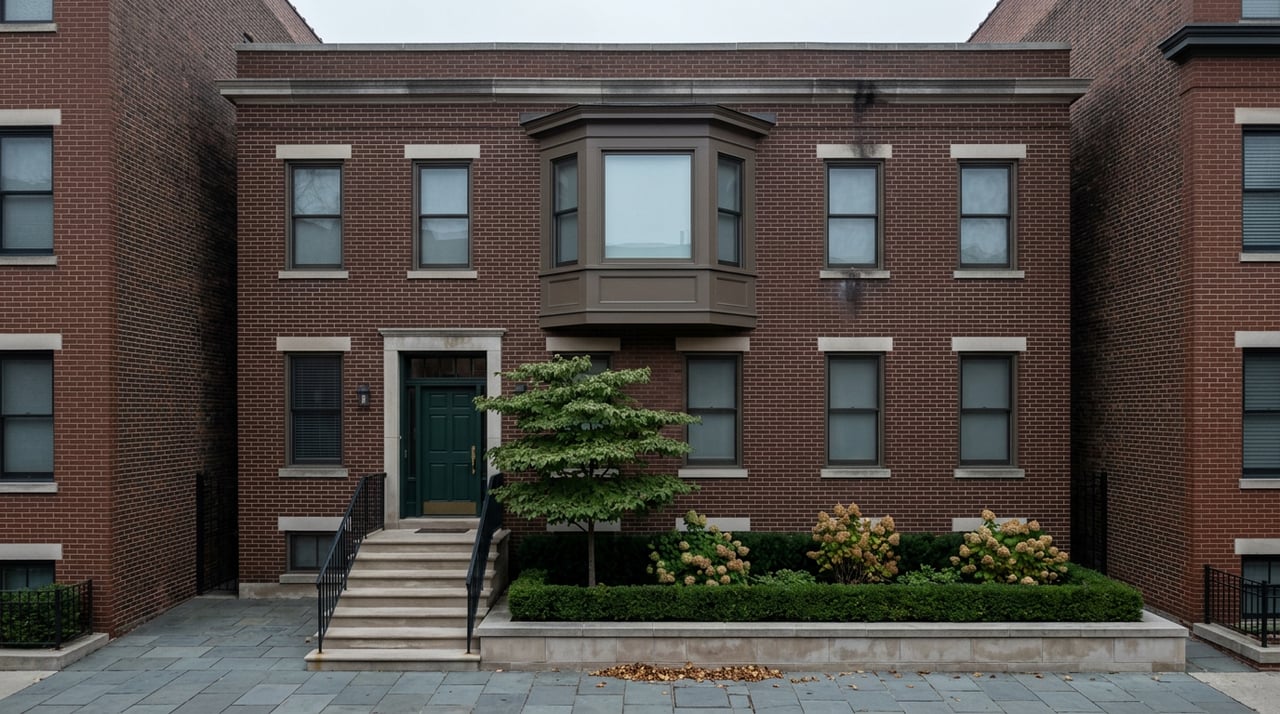
Even within the single-family tier, "Lakeview" isn't one price point. Local pricing generally sorts into three bands. A solid detached or semi-detached home in good condition on a standard block runs $800,000 to $1.5 million. Homes on the most sought-after blocks, or new construction, push into the $1.8 million to $2.5 million range, which is exactly where that April median landed. Beyond condition and square footage, location inside the neighborhood does most of the remaining work on price.
Blocks closest to Belmont Harbor and the lake, the stretch known as East Lakeview, trade at the top of that range for their quieter residential character and lakefront proximity. East Lakeview also carries the Belmont Theater District, a cluster of more than 30 theaters and live performance venues near the Belmont El station, according to DePaul University's Institute for Housing Studies, which helps explain why demand there holds even as inventory tightens across the rest of the neighborhood.
The Southport Corridor commands its own premium, tied directly to the retail street itself. Recent arrivals there, including STRONG Pilates and Colectivo Coffee, along with restaurants like Port & Park and the Japanese robata spot Itoko, have kept the corridor's foot traffic climbing, with the boutique Bobbles & Lace preparing to open on the same stretch, even as the housing stock around it stays fixed.
The blocks north of Addison near Wrigleyville tend to be the most attainable entry point into Lakeview single-family ownership. They're also where rental demand runs strongest, which is why cap rates on well-maintained two- and three-flat buildings in that stretch typically land in the 4 to 6 percent range for investors.
The West Lakeview Paradox
If you want a case study in how a small sample size can produce a genuinely misleading headline, look at West Lakeview. Over the three months ending March 2026, the median sale price there fell 11.7 percent year over year to $675,000. In the same window, the median price per square foot rose 23.9 percent, to $521. Only 23 homes sold in that period, matching the prior year's count exactly.
That's not a contradiction once you account for sample size. With 23 transactions, the mix of what happened to close, more smaller units one year, a couple of larger ones the next, can swing a median price without reflecting any real change in what a given square foot is worth. Price per square foot, calculated across that same small pool, is telling you the more stable story: values are climbing. The median is telling you something about which homes happened to sell, not what the market is doing to any specific property.
What the Bidding-War Numbers Mean If You're Writing an Offer This Fall
None of this is abstract if you're actually shopping. A Real Deal analysis of Redfin sales data pulled this spring found that across a region spanning Lincoln Park, Lakeview, Wicker Park, and Bucktown, about 70 percent of homes listed and sold within the prior month closed above asking price, with an average premium of just over $60,000, or 7.8 percent, on those over-ask sales. Folding in listings that sold at or below asking still left the group averaging 4.6 percent over.
One Lakeview sale this year shows how far that competition can push a single transaction. A four-bedroom, three-and-a-half-bath house of about 3,900 square feet listed at $1.75 million in early May and closed at $2.1 million, 20 percent above ask.
If you're comparing that outcome to a $520,000 blended median you saw on a portal, you're not just underprepared, you're solving the wrong problem. The question worth answering before you tour anything isn't "what's Lakeview's median price." It's "which of Lakeview's two markets does this specific property belong to, and what does competition actually look like there right now."
A Few Questions Worth Settling First
Why do Zillow and Redfin disagree on Lakeview's value? They're measuring different things. Zillow's typical value estimate spans the full housing stock, condos included, while Redfin's median tracks actual closed sales, which skew toward the smaller, pricier single-family pool. Neither figure is inaccurate. They're just answering different questions.
Does the single-family bidding war extend to condos? Not to the same intensity. With 159 condos on the market as of early September 2026 against roughly 10 single-family homes earlier in the year, condo buyers have far more room to be selective, even with typical days on market still running under five weeks.
Is a small multi-unit building a reasonable way into Lakeview for an investor? It can be. Cap rates on well-maintained two- and three-flats generally run 4 to 6 percent, with the strongest rental demand concentrated in the blocks north of Addison near Wrigleyville.
If you already own a single-family home in Lakeview, this scarcity is working in your favor right now, and the only way to know what that actually translates to in dollars is to look at your specific block and property type rather than a citywide blend. If you're the one searching, the same logic runs in reverse: know which of the two markets your target property sits in before you write the offer. NiKo Collaborative works both sides of that split every week across Lincoln Park, Lakeview, Bucktown, Logan Square, West Town, and downtown. Request a Home Valuation to see exactly where your property, or the block you're watching, actually sits inside Lakeview's two markets.