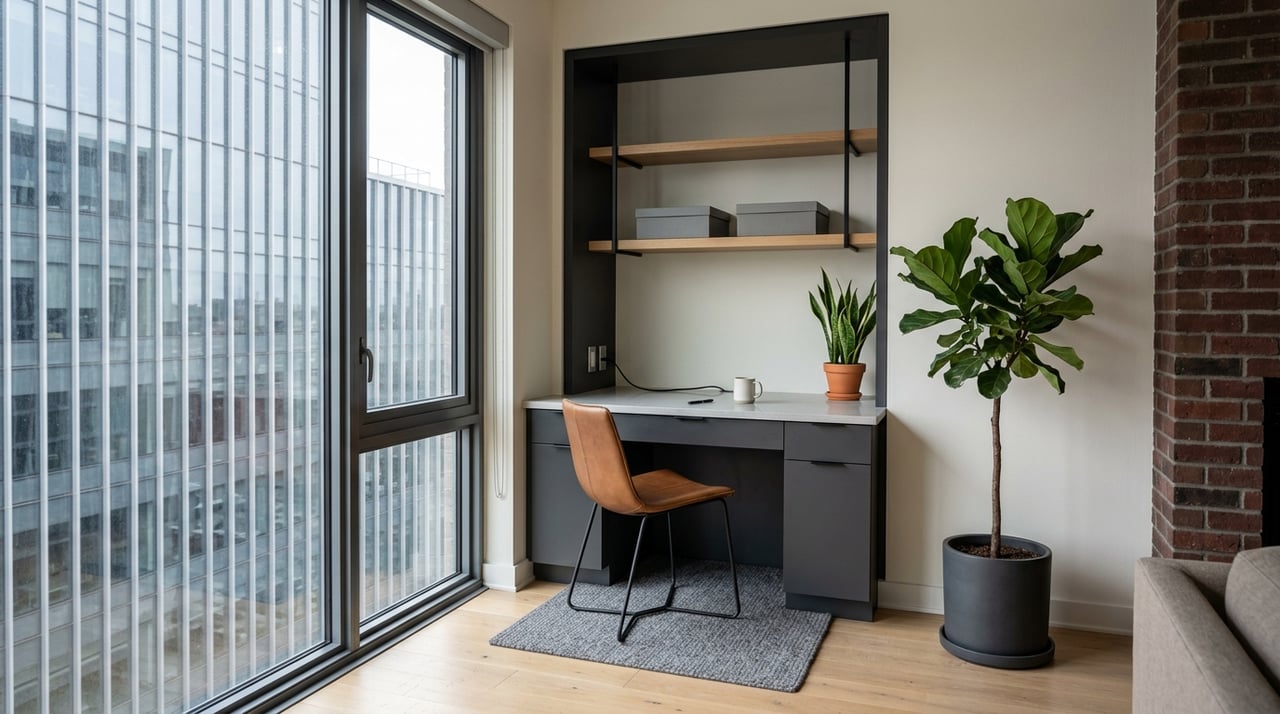
Are you buying a condo that looks great in photos, or one that will actually support your workday? If you work remotely, that difference matters more than ever in downtown Chicago, where your home may need to function as office, meeting room, recharge space, and backup plan for long days at your desk. The right condo can make your routine feel smooth and repeatable, and the wrong one can leave you dealing with noise, layout problems, and weak building systems. Let’s dive in.
Why remote workers need a different condo checklist
Remote and hybrid work are still a meaningful part of daily life. The U.S. Bureau of Labor Statistics reported that 22.6% of workers teleworked or worked at home for pay in March 2026, and the broader shift appears to be lasting.
That changes how you should evaluate a downtown Chicago condo. You are not just choosing finishes, views, or amenities. You are choosing a place where you may spend most of your weekdays thinking, taking calls, joining video meetings, and trying to focus.
Prioritize layout over looks
A skyline view is nice, but it does not create a productive workday. For most remote workers, the better question is whether the unit gives you a separable work zone that feels distinct from where you sleep or relax.
Look for a true den, a split-bedroom layout, or enough wall space to place a desk and monitors without forcing your workspace into the middle of the living room. If you regularly take calls, even a modest nook with some visual separation can work better than an open layout with no privacy.
Bedroom placement matters too. A bedroom buffered from street-facing walls or from high-traffic interior areas can make the whole unit feel calmer, especially if your work and sleep schedules overlap with downtown activity.
Pay close attention to noise
For remote workers, noise can be just as important as square footage. HUD guidance highlights a 45 dB interior noise goal and specifically notes the importance of quieter conditions for rooms like bedrooms.
In practical terms, that means you should ask how the unit is positioned. Does it face a busy street, rail line, river corridor, or nightlife-heavy block? Is it near elevators, trash rooms, or other interior activity points that could interrupt your day?
The surrounding subarea matters too. River North may offer easy access to restaurants and galleries, but it can also bring more ambient activity. The Loop offers a true downtown setting with strong civic and cultural access, while Streeterville brings lakefront access and what can feel like a somewhat steadier daily rhythm.
Evaluate windows like a remote worker
Windows do more than frame the view. According to the U.S. Department of Energy, efficient windows often use double or triple glazing, and lower-air-leakage window types with strong seals can improve performance.
For you, that can translate into a condo that feels more comfortable during long workdays. Better window systems can help with temperature control and may also be a useful clue that outside noise and drafts were taken seriously.
If possible, ask what kind of windows the unit has and whether they have been updated. Casement, awning, and hopper windows generally leak less air than sliding windows, which can matter if you are spending full weekdays inside.
Check whether outdoor space is truly usable
A small balcony or terrace can be a major quality-of-life feature when you work from home. It can give you a place to step out between meetings, take a private phone call, or reset without leaving the building.
But in an Illinois condo, outdoor areas such as balconies, terraces, patios, and parking spaces are often treated as limited common elements. That matters because changes or modifications typically require written board approval, and maintenance responsibilities may not be as simple as they first appear.
In other words, do not just note that outdoor space exists. Ask whether it is usable, well maintained, and governed in a way that supports how you actually want to use it.
Building systems matter more than flashy amenities
When you work remotely, a condo building’s infrastructure can affect your day more than a rooftop lounge ever will. Illinois guidance notes that common elements can include electrical wiring, conduits, central heating and air, utility lines, roofs, hallways, entrances, exits, and storage areas.
That means your daily comfort depends partly on how well the association maintains shared systems. If HVAC reliability, electrical service, or building-wide maintenance is weak, your workday may feel less predictable no matter how attractive the lobby looks.
This is why ownership documents matter. A well-run building should have accessible governing documents, recent budgets, contracts, insurance information, reserve studies, and meeting minutes available for inspection rights outlined under Illinois guidance.
Review reserves and recent building decisions
For a remote worker, reserve health is not just a financial detail. Illinois says boards must provide for reasonable reserves for repair or replacement of common elements unless that requirement has been waived in the condominium instruments.
Why does that matter to you? Underfunded reserves can lead to deferred maintenance, special assessments, or underperforming shared systems. If the building has been postponing major work, that may eventually affect elevators, heating and cooling systems, roofs, windows, or other essentials that shape your day-to-day experience.
Recent meeting minutes can also tell you a lot. They may reveal recurring building issues, planned projects, policy debates, or quality-of-life concerns that do not show up in listing photos.
Verify internet service by address
Never assume strong internet just because a condo is in a downtown tower. Broadband availability is address-specific, and the FCC National Broadband Map allows users to search a street address and review reported providers, technology types, and speeds.
This matters because one building may have solid options while a nearby one does not offer the same service mix. If your job depends on video calls, large file uploads, or consistent connectivity, address-level verification should be part of your screening process.
There is good reason to expect strong connectivity in parts of the downtown core. Comcast has reported added fiber reaching more than 200 downtown Chicago businesses in the Loop, South Loop, and West Loop, with speeds up to 10 Gbps in those buildouts. Still, your condo decision should rest on the exact address, not on neighborhood assumptions.
Match the subarea to your work style
Not every downtown Chicago location supports the same kind of remote-work lifestyle. The best fit depends on how much outside energy you want around your building and what kind of breaks help you recharge.
The Loop for civic energy
The Loop is Chicago’s official downtown and central business district. It offers access to the Riverwalk, Millennium Park, theatre, dining, architecture, and the Chicago Cultural Center.
If you like stepping out into a highly active urban setting, this area can make it easy to break up your day with a walk, lunch, or cultural stop. It may appeal to remote workers who want downtown energy close at hand.
River North for dining and activity
River North is known for art, design, restaurants, and nightlife. That can be convenient if you enjoy having lots of options nearby after work or between meetings.
At the same time, more activity can also mean more ambient noise depending on the building and block. Here, the right unit orientation and sound control become especially important.
Streeterville for lakefront access
Streeterville offers access to Navy Pier, the Lakefront Trail, museums, and dining. Compared with some other downtown areas, it can offer a daily rhythm that feels more centered on the lakefront and public spaces.
If fresh air, walking routes, and a change of scenery are part of how you manage your workday, this setting may be worth a closer look.
Think beyond the condo walls
A remote-friendly home is not just about what happens inside the unit. It is also about what is available nearby when you need a change of scene, a quieter setup, or a quick break that helps you reset.
The Harold Washington Library Center offers WiFi, computers, scanners, study rooms, and meeting rooms, and Chicago Public Library also provides study rooms at branches including Near North and West Loop. For many buyers, those are practical backup spaces rather than just nice extras.
Public spaces can also become part of your work rhythm. The Chicago Riverwalk offers a waterfront pedestrian route with benches and lookout points, while Millennium Park and the Chicago Cultural Center provide free events and exhibits. Those places can support walking calls, lunch breaks, or short mental resets without requiring a full commute.
A smart condo search starts with repeatability
The best downtown Chicago condo for remote work is usually not the one with the most dramatic view or the flashiest amenities. It is the one that helps your workday feel contained, comfortable, and easy to repeat.
That means looking closely at layout, noise, windows, outdoor space, shared systems, reserve health, internet options, and the rhythm of the surrounding blocks. If you want help weighing those details in a real-world Chicago search, Niko Apostal can help you evaluate condos with both lifestyle and long-term value in mind.
FAQs
What condo layout works best for remote work in downtown Chicago?
- A layout with a true den, split bedrooms, or a clear area for a desk and monitors usually works best because it creates a more separate and functional work zone.
How important is noise when buying a downtown Chicago condo for remote work?
- Noise is very important because your condo may need to support calls, focus time, and rest, so unit location, building design, and window quality all matter.
Should remote workers verify internet service before buying a Chicago condo?
- Yes, internet service should be verified by exact address since broadband availability, providers, and speeds can vary from one building to the next.
What building documents should remote workers review before buying a Chicago condo?
- You should review the declaration, bylaws, rules, recent budgets, reserve study, and recent meeting minutes to better understand maintenance, building systems, and financial health.
Which downtown Chicago area is best for remote workers?
- The best area depends on your work style, since the Loop offers core downtown access, River North offers more dining and nightlife activity, and Streeterville offers strong lakefront access and public-space options.